A half-empty round is expensive. You can be working all day yet losing time and fuel travelling between jobs, especially when customers are spread across several estates or villages. That is why window cleaners often ask: is door canvassing effective when the aim is not just more work, but a tighter, more profitable recurring round?
For the right type of window-cleaning business, it can be one of the most direct ways to gain domestic customers. It puts a real person in front of households in the exact streets you want to serve, explains the regular service clearly and asks for the booking there and then. There is no waiting for someone to search online, notice an advert or fill in a form at a later date.
But canvassing is not magic. Results depend on the area, the offer, the person at the door and, above all, whether you are targeting streets that make commercial sense for your existing route.
Why door canvassing suits recurring window-cleaning rounds
Window cleaning is built on repeat custom. A domestic customer who wants their windows cleaned every four or eight weeks has a value well beyond the first visit. Add several customers on the same few streets and the benefit is bigger still: less travelling, more work completed per day and a round that is easier to manage.
Door canvassing is particularly well suited to this model because it reaches households by location, not by broad interest. You choose the estate, postcode sector or group of streets. The canvasser then speaks with residents in that area about a regular service. That means every sign-up has the potential to sit close to other work you already do.
Compare that with general advertising. An online enquiry may come from anywhere within a wide radius. It might be a one-off request, outside your preferred patch or from someone simply comparing prices. Advertising has its place, but it does not always give you the control needed to build density into a round.
A doorstep conversation also allows simple questions to be answered immediately. How often do you clean? Do you clean frames and sills? How will the cleaner gain access? When is the first clean likely to take place? For many householders, a clear answer from a local representative is enough to turn interest into a recurring sign-up.
Is door canvassing effective in every area?
No. The area matters as much as the method.
A good canvassing area usually has a high number of suitable houses, straightforward access and enough properties close together to make repeat visits efficient. It may be an estate where you already have a handful of customers, a new housing development, or a neighbouring patch that fits naturally into your current route.
An isolated rural area may still produce customers, but each customer can carry more travelling time. A street full of flats may need a different approach because access, communal entrances and managing agents can complicate the service. Likewise, an area where most homes already use another cleaner may take more effort than a new development where routines are still being established.
This does not mean you should avoid a difficult area automatically. It means you should decide what a new customer is worth to your business before you start. A regular customer next door to three existing jobs is worth more operationally than one at the far edge of your working radius.
The most effective campaigns are planned around your round, not around a random map. Start where you already work, then grow outwards street by street. This keeps routes compact and makes it easier to give new customers a reliable service from their first clean.
What makes a doorstep campaign convert
People do not sign up because someone simply knocks on the door. They sign up when the offer is clear, credible and easy to act on.
For window cleaning, that usually means explaining that the service is regular, what is included and how often the windows will be cleaned. Residents should know that they are dealing with a local, insured business or a representative working on its behalf, rather than someone making vague promises at the door.
Pricing also needs to be handled plainly. A household does not need a long sales pitch. They need to understand the expected price, the frequency and what happens next. If a first clean costs more because of an initial build-up of dirt, that should be explained upfront. Clear expectations prevent cancellations later.
Timing affects results too. Canvassing when more residents are likely to be at home gives more opportunities for genuine conversations. Weather, school holidays and local routines can all influence response. A professional canvasser will expect refusals and unanswered doors. The point is not for every door to say yes. The point is to secure enough suitable repeat customers in the chosen area to improve the round.
The trade-off: time versus acquisition cost
Many window cleaners know they could knock doors themselves. The problem is that canvassing takes time away from cleaning, quoting, collecting payments and looking after existing customers.
If you are already fully booked during the day, spending evenings or weekends prospecting can be tiring and inconsistent. You may also be tempted to stop after a few rejections, even though canvassing works through steady coverage rather than a handful of conversations.
Using a specialist service shifts that work away from you. You still control the area and the number of customers you want, but you are not the one walking the streets. This is useful when you want to fill a few gaps, add a new section to an existing round or launch a round in a new location without losing billable hours.
The key question is not whether there is a cost to acquiring a customer. There is always a cost, whether it is your own time, paid advertising or professional canvassing. The useful question is whether the cost is clear and whether the customer is likely to generate enough recurring revenue to justify it.
A one-off acquisition fee per customer is easier to assess than an open-ended monthly marketing bill. You can compare that fee with the likely value of a regular customer over several cleans, while also considering the extra efficiency created when that customer sits within a dense route.
How to judge whether your canvassing is working
Do not judge a campaign only by how many names are collected. Judge it by the quality and fit of the customers added to your round.
First, look at location. Are the sign-ups grouped together, or are they scattered across your patch? Next, look at retention. Do customers proceed with the first clean and stay on the regular schedule? Finally, look at the practical effect on your week. Can you complete more work in the same number of hours because the route is tighter?
It is also worth tracking the value of a sign-up over time. A customer paying a modest amount every four weeks can become valuable quickly when they remain on the round for years. If several of those customers are on the same estate, the return is not just revenue. It is a more efficient working day.
Keep your expectations realistic. Some people will say no, some will need time to decide and some will cancel after the first clean. That is normal. The measure of a good campaign is whether it produces enough reliable, well-located customers to move the business forward.
A practical way to start
Choose a small, sensible target area rather than trying to cover a whole town at once. Ideally, pick streets close to current work where even a few additional recurring sign-ups would reduce gaps in the day. Decide how many customers you can comfortably take on, then make sure your pricing, frequency and service details are ready before canvassing begins.
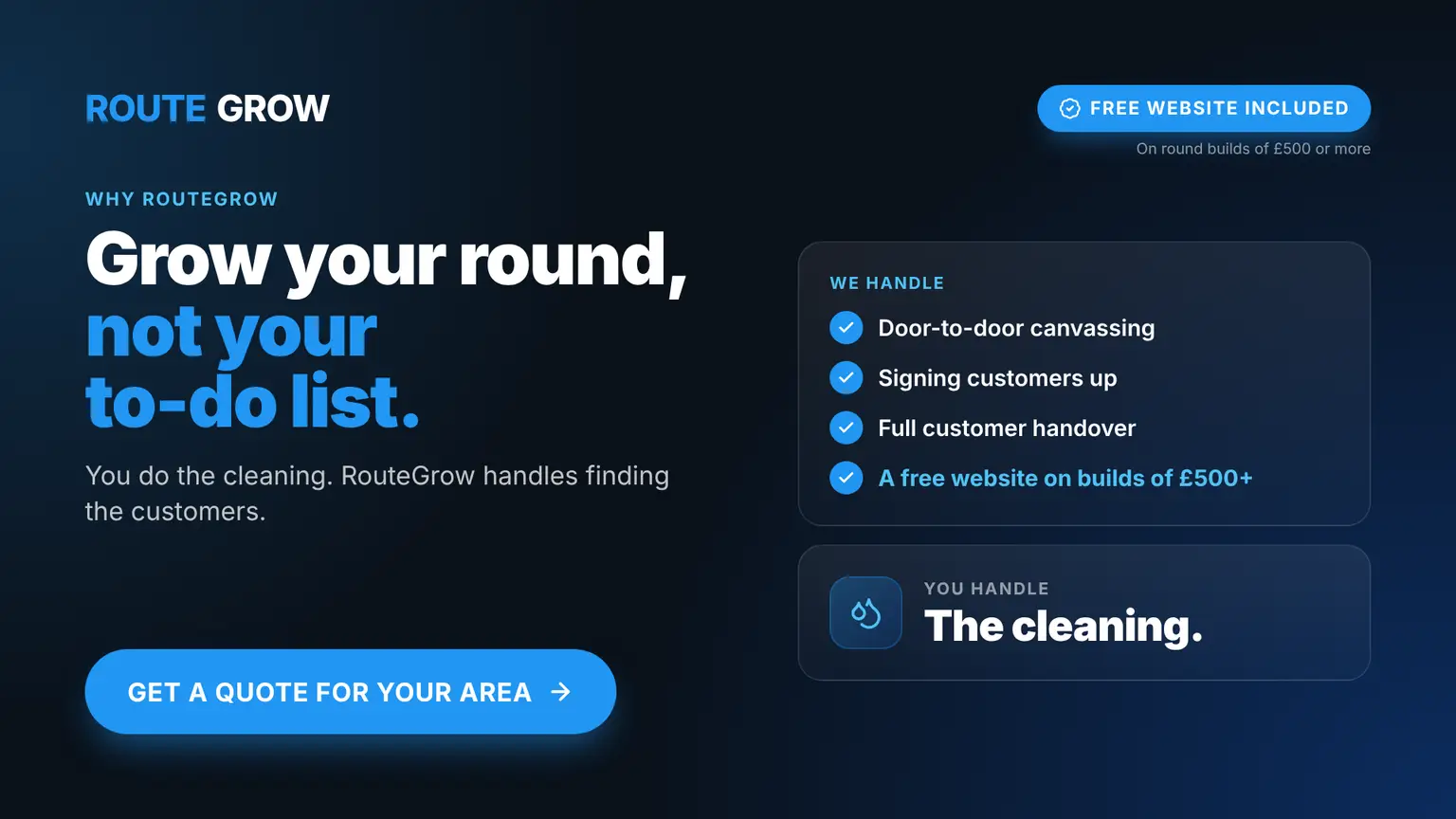
Route Grow works this way: you select the area, canvassers speak directly with local residents, and you receive recurring sign-ups without a minimum order or ongoing monthly fee. That gives a cleaner the option to test a small expansion first instead of committing to a large campaign.
Door canvassing is most effective when it is treated as route building, not just lead generation. Put the effort into the streets you genuinely want to work, deliver the first cleans well and let each compact group of new customers make the next stage of growth easier.