A gap in your round is not just a gap in turnover. It can mean extra driving, more dead time between jobs and a weaker route that takes longer to service. That is why canvassing versus online advertising is not simply a marketing choice for window cleaners. It is a decision about how you build profitable, repeatable work in the areas you already cover.
Both methods can bring in new customers. The difference is in the level of control, the type of enquiry you receive and whether the work helps create a tighter domestic round. For most window cleaners, the best option depends on the stage of the business and the exact area they want to grow.
Canvassing versus online advertising: the practical difference
Door-to-door canvassing starts with a chosen area. A canvasser speaks with residents, explains the service and secures recurring sign-ups from households that want regular window cleaning. The aim is clear: add customers near existing work, or build enough demand in one place to start a new round.
Online advertising puts your business in front of people searching or browsing online. This might include paid search, social media adverts or local lead-generation platforms. A potential customer sees an advert, gets in touch and you then turn that enquiry into a regular job.
Neither route is automatically right or wrong. The question is whether it produces the sort of customers your business needs. A domestic round works best when jobs are close together, customers are booked regularly and travelling is kept under control. An advert may generate an enquiry from anywhere within a wide radius. Canvassing lets you focus the customer acquisition activity on the streets you actually want to work.
Why customer density matters more than lead volume
A busy phone can feel like progress, but leads are not the same as a strong round. If five new customers are spread across five different estates, they may add revenue while also adding fuel costs, travelling time and awkward gaps in the day.
A smaller number of recurring customers on the same estate can be worth more. You can move from one property to the next, offer reliable days, and fit more work into the same number of hours. That is the commercial advantage of targeted canvassing. It is built around where the work sits, not just how many names come through.
Online advertising can be targeted by postcode, town or radius, but it does not guarantee that the people responding will be located on the streets you need. You may be paying to reach a broad local audience, then spending time filtering enquiries that are too far away or unsuitable for your schedule.
This does not make online advertising useless. It can work well when you have spare capacity across a larger area, when you are testing demand in a new town, or when you want to pick up customers who are actively searching for a cleaner. But if your priority is filling a particular patch, door-to-door prospecting is usually more precise.
Comparing the cost of each approach
The right acquisition cost is not simply the cheapest upfront figure. It is the cost of gaining a good recurring customer who fits your round and stays on it.
With online advertising, you may pay for clicks, impressions, leads or a monthly agency service. Those costs can continue whether or not customers sign up. You may also need to allow for the time spent responding to messages, chasing people who go quiet, quoting, and sorting out whether an enquiry is in the right area.
Some cleaners are comfortable managing this themselves. Others find that the campaign needs regular attention to keep it working. Advert copy, budgets, targeting and follow-up all affect results. If you are cleaning all day, that administration can end up being done in the evening, or not done as quickly as it should be.
Canvassing is more straightforward when it is priced per customer gained. You know what you are paying for each recurring sign-up, rather than paying an ongoing fee for activity with no assured outcome. It also makes it easier to decide how many customers you want and what level of investment makes sense for your round.
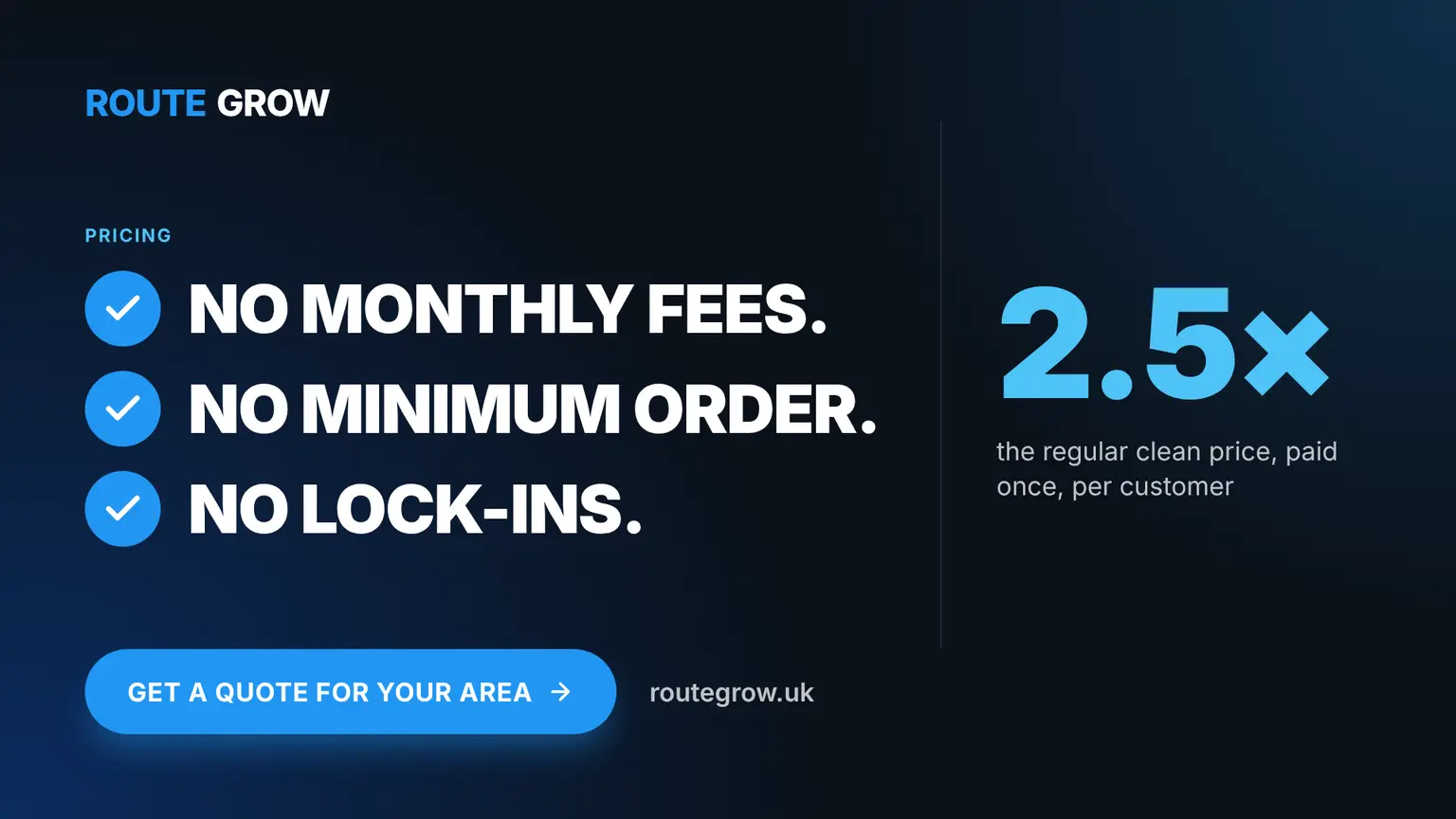
Route Grow works on this basis: you choose the area, residents are canvassed and you pay a one-off acquisition fee for each new customer gained. There is no minimum order and no monthly fee. That can suit a sole trader who only needs a handful of nearby jobs just as well as an operator building a new round from scratch.
Of course, price should not be judged in isolation. A low-cost customer several miles from your existing route may be more expensive in practice than a higher-cost customer two streets away. Look at the likely lifetime value of the job, the cleaning frequency, access, property type and how easily it fits into your day.
The time question: who does the prospecting?
For many window cleaners, the biggest issue is not whether they can knock doors. It is whether they can do it consistently without giving up paid work. Canvassing takes persistence. You need to choose streets, knock at suitable times, handle questions, record details and return often enough to build momentum.
Doing it yourself can be worthwhile if you have time available and enjoy speaking with residents. It also gives you direct local knowledge. You will quickly learn which roads respond well, what service schedules people prefer and where there is clear room for another cleaner.
But there is a trade-off. Every hour spent prospecting is an hour not spent cleaning, quoting for larger work, maintaining equipment or dealing with existing customers. Outsourced canvassing removes that pressure while keeping the focus on local, recurring work.
Online advertising can look less time-intensive because the advert is always running. In reality, fast follow-up matters. A resident who has sent three enquiries may book the cleaner who replies first. If you are on ladders or moving between jobs, managing messages and calls can be difficult. Missed enquiries are paid-for opportunities that disappear.
Trust and the type of customer you gain
A resident who speaks to a canvasser has a real conversation before signing up. They can ask about frequency, payment, access and what is included. That does not mean every sign-up will remain forever, but it gives the customer more context than a brief advert viewed while scrolling on a phone.
Online leads can be high intent, particularly when someone is actively looking for a window cleaner. They may already know they want the service and be ready to arrange a visit. The drawback is that they are often comparing several businesses at once, with price becoming the quickest point of comparison.
Door-to-door sign-ups are different. The conversation is local and immediate. Residents can see that the service is being offered specifically in their area, which can make regular cleaning feel more convenient. When nearby houses are also joining, it supports the sense that the cleaner will be working on that street anyway.
The quality of either customer still depends on clear expectations. Be upfront about your service frequency, payment method, weather delays and whether you clean frames, sills or doors. A customer who understands the arrangement at the start is more likely to become dependable repeat work.
When online advertising is the better fit
Online advertising has a place when its strengths match your objective. If you cover a broad territory and have plenty of room in the diary, wider enquiries may be useful. It can also help an established business maintain visibility, support a new service or attract commercial enquiries that are less dependent on street-by-street density.
It may suit you if you are confident handling digital campaigns, have someone available to answer leads quickly and can measure which adverts create genuine recurring customers rather than one-off enquiries. The key is to track more than clicks. Record where each customer lives, what they pay, how often they are cleaned and whether they fit the route.
Avoid treating an advert budget as a set-and-forget expense. If the leads are coming from the wrong areas or are only chasing the lowest price, change the targeting or stop spending. Good growth is controlled growth.
When canvassing is the better fit
Canvassing is usually the stronger choice when you want to fill gaps around existing customers, create a dense run in a chosen estate or launch a new domestic round in a specific area. It is also useful when you want a clear connection between the money spent and the customers added.
It gives you control over geography. Rather than hoping the right household sees an advert, you approach the households on the roads that make commercial sense. That matters most for a business whose profit is shaped by the number of properties it can clean in a day, not just by its headline customer count.
The best approach is often not a permanent either-or decision. You might use canvassing to build the core of a new, tightly packed round, then use carefully targeted online advertising to catch local demand or keep the diary topped up. Just make sure each method has a job to do and is measured against the same standard: recurring customers in the right places.
The next customer should make your working day easier, not longer. Choose the acquisition method that puts more regular jobs on the roads you want to clean, at a cost you can see and control.