A good canvassing result is not simply a pile of new names. For window cleaners, canvassing results for cleaners should mean recurring sign-ups in the right streets, at prices that work for the round and with enough local density to make every visit worthwhile. Ten customers scattered across a wide area can create more driving than profit. Five customers on streets you already work can change the value of a day.
That is why door-to-door canvassing works best when it is treated as a route-building job, not a vague marketing exercise. The target is regular domestic work that fits the way you already operate, or gives a new round a sensible place to start.
What good canvassing results look like
The headline number matters, but it is only the first measure. A new customer should be assessed by what they add to the business over time: their cleaning frequency, likely job value, location, access requirements and how close they are to existing work.
A customer who books every four or eight weeks on a compact estate can be worth far more than a higher-priced job twenty minutes away. The cleaner spends less time travelling, can finish more houses in a day and has a stronger reason to be in that area when weather or access causes changes to the schedule.
For an established round, the strongest result is usually infill. This means adding customers between homes you already clean, on adjacent roads or within a small, manageable patch. For a new operator, the goal may be a starter cluster: enough recurring customers in one chosen area to justify returning regularly and building from there.
There is no single conversion rate that applies to every doorstep. Results depend on the area, the time of year, the offer, the level of local competition and whether residents already have a cleaner. A realistic approach looks at the quality and location of the sign-ups, rather than promising that every door will produce a customer.
Why the chosen area affects everything
A well-chosen area gives canvassing a clear commercial purpose. It could be a neighbourhood where you already have several regular customers, a nearby estate with suitable property types, or a place you can service on a particular day of the week.
The best streets are not always the biggest houses or the newest development. Larger properties may carry a higher price, but they can take longer and have more detailed access arrangements. New-build estates can offer opportunity, yet residents may be moving in gradually or already receiving plenty of marketing. Older streets may have established cleaning habits and more demand for a reliable replacement.
Before any canvassing starts, be clear about the practical boundaries. Consider where you are prepared to work, what minimum job value makes sense, whether you clean fronts only or full cleans, and how often you want to visit. If your round is already full on Tuesdays and Thursdays, there is little value in gaining a cluster that can only be serviced on those days.
This is where local knowledge from the cleaner matters. A canvassing team can work the chosen area and speak to residents, but you know which roads are awkward for parking, which addresses have difficult rear access and which parts of town fit naturally around your existing work.
Density beats raw customer numbers
It is tempting to judge a campaign by the total number of new customers alone. In practice, density is what protects margin. A round with short walks between properties can absorb the usual realities of window cleaning: locked gates, bad weather, cancellations, card payment follow-ups and the occasional job that takes longer than expected.
Think about the result in terms of minutes, not just customers. If a sign-up adds two minutes of travelling and twenty minutes of work to a day that already takes you past the property, it is useful. If it adds twenty minutes of travelling for a similar job, it needs to command a higher price or become the first of several nearby customers.
Canvassing can create that critical mass, particularly when the work is focused tightly rather than spread across several postcodes.
Setting the right expectations before doors are knocked
Clear instructions produce better-fit enquiries and sign-ups. Residents need to understand what they are agreeing to, and you need customers who suit your service rather than one-off enquiries that will not form part of a recurring round.
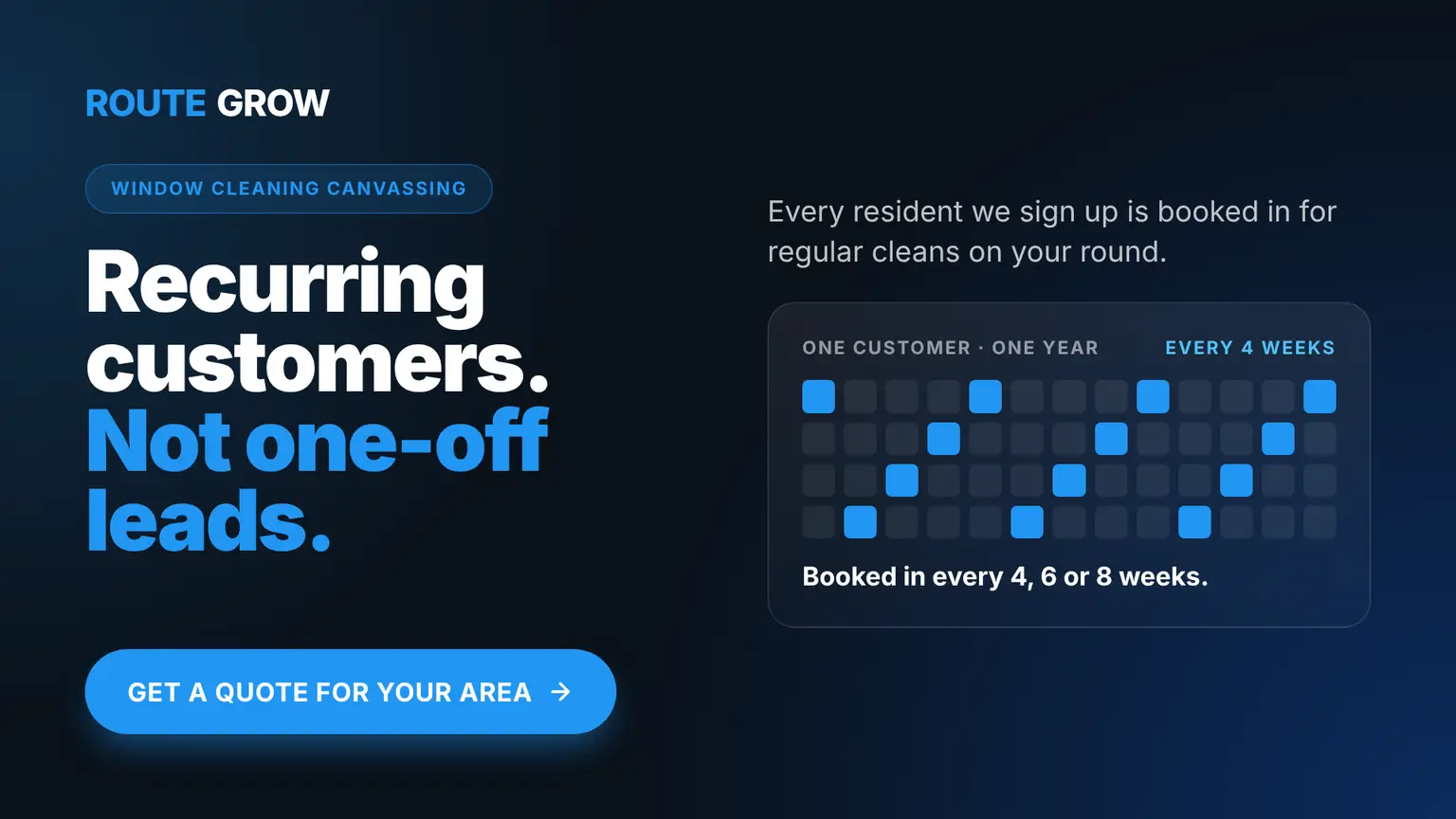
Set out the service in straightforward terms: the type of clean offered, the regularity, the approximate price range where appropriate and the payment method you use. If you only take on customers who want a regular four-weekly service, that should be clear from the start. It saves time later and reduces the chance of a customer expecting something different.
You should also decide what happens after a sign-up. Speed matters. A prompt welcome message or call confirms the arrangement, checks access details and gives the customer confidence that they have chosen a genuine local service. Leaving new customers without contact for weeks risks avoidable drop-off, especially if their first clean is not due immediately.
For some businesses, a small number of carefully selected new customers is the right result. For others, the aim is to launch a whole new day on the round. The commercial model should support both. There is little sense in forcing a cleaner into a large campaign when they only need a few nearby jobs to fill a gap.
Measuring canvassing results for cleaners properly
The simplest question is whether the acquisition cost can be recovered quickly from recurring work. But do not stop at the first clean. A recurring customer has value across many visits, provided the price, frequency and route position are sensible.
Start by recording the first clean price, the regular price, cleaning frequency and the road. Then review how long the work takes once it has settled into the route. An initial clean can be slower, so judging the customer solely on that visit can give a misleading picture.
It also helps to track four practical measures over the next few months:
- the number of recurring customers gained in the chosen patch
- the average value of each regular clean
- the travel time added or removed from that day’s route
- the number of customers who remain active after their first few visits
These figures show whether the campaign built a workable round rather than merely generating initial interest. They also make the next decision easier. If one estate produces good-value customers close together, it may be worth returning there. If another produces low-value jobs spread too widely, tighten the area or adjust the service criteria.
The cost question: pay for customers, not noise
Many cleaners have tried leaflets, social adverts or paid lead sites. Each can have a place, but they often require ongoing spend, follow-up time and a willingness to sort serious enquiries from people who only want the cheapest one-off clean.
Door-to-door canvassing is different because it puts a person in front of residents in a chosen location and focuses on repeat-service sign-ups. It still requires realistic expectations: not every conversation becomes a customer, and no area is identical. The value comes from putting effort where it can build the route you actually want.
Route Grow works on a simple basis: you select the area, canvassing is carried out locally, and you pay a one-off acquisition fee for each customer gained. There is no minimum order and no monthly fee. That gives sole traders room to add a handful of jobs, while larger operators can use the same approach to develop a new patch.
The right acquisition cost depends on the lifetime value of the customer and the efficiency of the route. A customer acquired for a clear fee can be easy to assess when they become part of a regular, profitable day. A cheaper lead that never books, cancels after one visit or sits outside your working area is not necessarily cheaper at all.
Turn sign-ups into a stronger round
Canvassing does not end when the resident agrees to regular cleaning. The first few weeks determine whether that new name becomes dependable income. Confirm the first visit, explain how payments work, record gate and access details, and make sure the customer knows how to contact you if something changes.
Then keep an eye on where the work sits. If a new cluster begins to form, organise the route around it rather than adding jobs in the order they arrived. A few small scheduling changes can turn an untidy day into a productive one.
The useful measure is simple: are your new customers making the round fuller, tighter and easier to run? When the answer is yes, canvassing has done more than add work. It has given you a better business to take out on the road next week.