A homeowner answers the door, asks who you are and whether you are local. The answer they receive shapes their view of your window-cleaning business before you ever clean a pane. So, can canvassers represent my business properly? Yes, provided they understand the service, work to clear standards and are focused on gaining the right recurring customers rather than simply collecting names.
For a window cleaner, door-to-door canvassing is not just a way to find leads. It is the first stage of customer service. The person on the doorstep needs to explain your offer clearly, handle basic questions honestly and leave residents feeling comfortable about signing up. Done well, it brings repeat work into the areas you have chosen. Done poorly, it can waste time, create unrealistic expectations and damage trust.
What good representation looks like on the doorstep
A canvasser should sound like an extension of your business, not a generic salesperson working from a script. That starts with the basics: who they represent, what service is being offered, how often it is likely to be carried out and what the customer can expect next.
For domestic window cleaning, residents usually want straightforward answers. Will the cleaner cover their street? Is it a regular service or a one-off? How will they know when the visit is due? What happens if access is not available? A capable canvasser does not invent answers to get a quick yes. They set out the arrangement accurately and pass on the details needed for a smooth first clean.
This matters because the best customer is not merely one who agrees on the doorstep. It is one who is happy to remain on the round. Recurring sign-ups give you predictable work and make the cost of acquiring a customer worthwhile. A rushed or misleading sale may produce a cancellation before you have even visited.
Good representation also means being polite when the answer is no. Residents should never feel pressured, misled or disturbed repeatedly. A professional canvassing team accepts a refusal, respects the property and moves on. That protects the reputation you have built locally.
Can canvassers represent your business in your chosen area?
They can, but only when the campaign is planned around your actual round rather than a vague target of getting more customers. You know that ten properties on one street can be worth far more than ten properties scattered across several villages. Less travelling, fewer gaps in the day and a tighter round all improve the value of each job.
Before canvassing starts, be clear about the areas you want to fill. This could be streets around an existing customer cluster, an estate where you want to establish a new round, or a postcode sector that fits naturally into your working week. It may also mean avoiding areas that look close on a map but are awkward to service in practice.
The canvasser should work within those boundaries. They also need enough information to describe the service accurately. If you only provide regular cleans, that should be clear. If certain property types take longer or require separate pricing, the sign-up process should account for it. The same applies if you have limits on access, conservatory roofs or difficult rear windows.
There is a trade-off here. The tighter the area and the more specific the customer criteria, the more controlled the round-building process becomes. It can also take longer to reach a particular number of sign-ups. That is usually better than gaining customers who do not fit your route, pricing or service model.
The details a canvasser needs from you
You do not need to hand over a large marketing pack, but a canvassing partner cannot represent your business well without practical information. Agree the service areas, the types of household you want to target and the regularity of the service. Confirm how prices are handled and what information must be captured at sign-up.
For example, a useful customer record should normally include the full address, contact details, agreed price or price basis, access notes and any relevant details about the property. If customers are expected to pay by bank transfer, direct debit or another method, that should be communicated correctly from the beginning.
It also helps to decide what happens after a resident signs up. Will you contact them before the first clean? Will the first visit take place within a set timeframe? Who deals with a question about the price or the frequency? A clear handover stops the customer feeling as though they have signed up with one business and been passed to another.
You should also be realistic about your availability. There is little value in gaining a strong batch of customers if you cannot start servicing them for months. Canvassing works best when new customers can be added to the round promptly and their first experience matches what they were told on the doorstep.
How to protect your reputation while growing
The concern behind the question, “can canvassers represent my business?”, is usually reputation. You have likely won existing customers through reliable work, friendly service and word of mouth. Bringing in outside help should support that reputation, not put it at risk.
Start by choosing a service that specialises in acquiring customers for recurring rounds. Door-to-door sales for home services are different from selling a one-off product. The aim is not a flashy pitch. It is a clear conversation that identifies households willing to use a regular local cleaner.
Ask how the team explains the service, how it records sign-ups and how customer details reach you. Find out whether you can select the location, whether there is a minimum order and whether you are paying for activity or for actual customers gained. These are commercial questions, but they also reveal whether the provider is set up to work as a practical partner.
A performance-focused model is often easier to control. If you pay a one-off acquisition fee per customer gained, you can decide how many additional jobs you need and when. You are not tied into an ongoing monthly fee while waiting to see whether the campaign produces useful work. This can suit a sole trader looking to fill a few gaps as much as a growing company launching a new round.
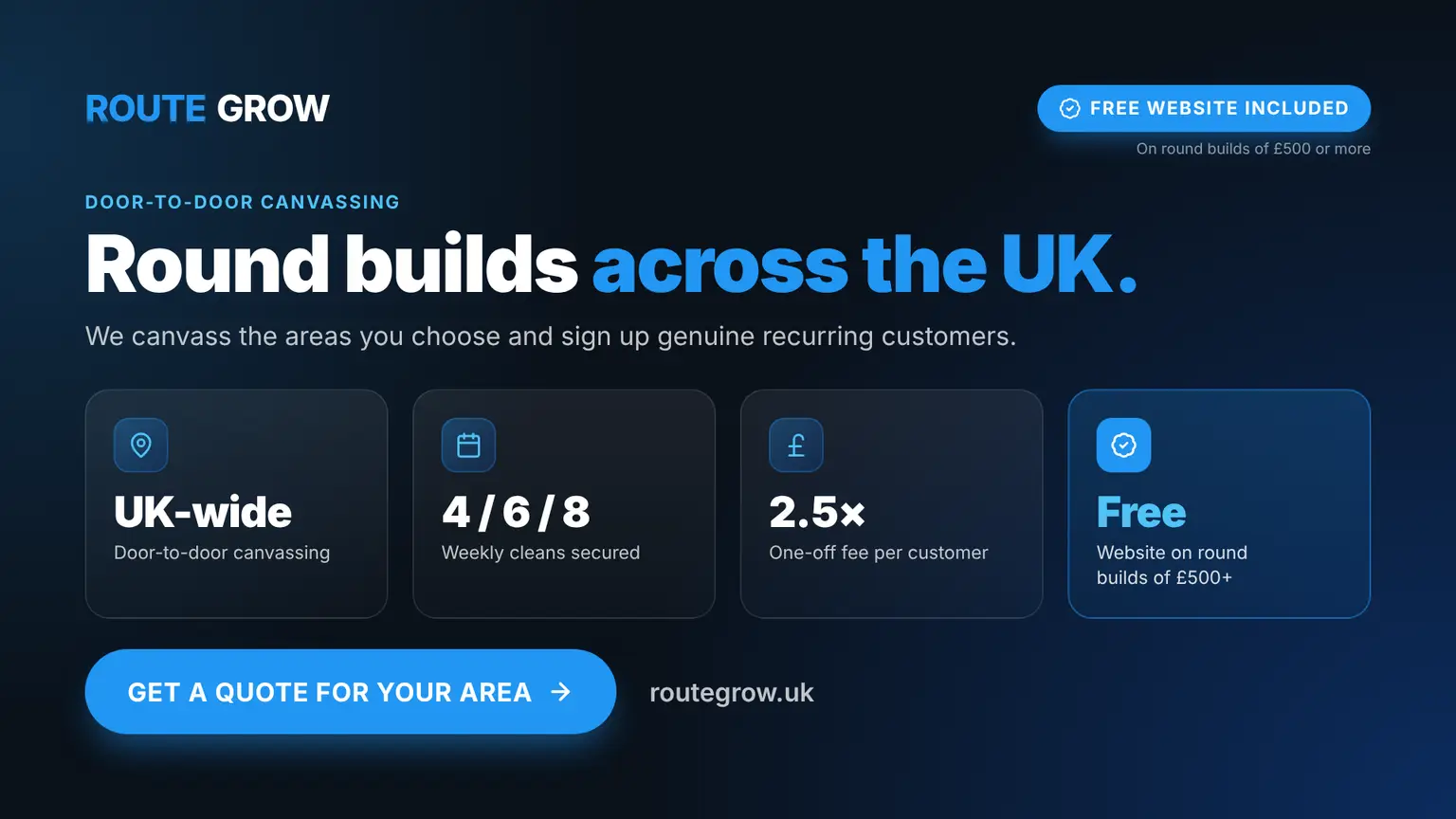
Route Grow works in chosen areas, speaks directly with residents and secures recurring sign-ups for window cleaners. There is no minimum order and no monthly fee, which means you can build at a pace that fits your capacity rather than committing to a large campaign before you are ready.
What a canvasser should never promise
Even a well-run campaign needs boundaries. A canvasser should not guarantee an exact cleaning day unless that has been agreed. They should not quote a fixed price for an unusual property if your process requires you to assess it first. Nor should they promise services you do not offer, such as gutter clearing, pressure washing or interior cleaning, simply because a resident asks.
They should also avoid suggesting that every home will be cleaned on the same schedule regardless of weather, access or seasonal changes. Window cleaning is a practical service. Customers generally understand that, as long as the arrangement is explained plainly.
Where a question falls outside the agreed information, the right response is simple: the cleaner will confirm it before the first visit. Honest expectations are better than a sale that creates a difficult conversation later.
Measuring whether the representation is working
The first measure is the number of recurring customers added in an area you can service efficiently. But do not stop there. Track how many remain after the first few cleans, how many have accurate details and how many fit the price and route you intended to build.
Pay attention to early feedback. If several customers ask the same question, there may be a gap in the message being used on the doorstep. If customers are cancelling because they expected a different frequency or price, correct it quickly. A good canvassing arrangement should be accountable enough to improve as you learn what works in each area.
You can also assess the effect on your day. Are you spending less time travelling? Are there fewer empty spaces between jobs? Can you add an extra street without extending your working hours? Those are the operational gains that make customer acquisition useful, rather than just busy.
The right canvasser does more than knock on doors. They help turn a chosen patch into a workable round, while you stay focused on delivering a reliable clean. Set clear expectations, keep the handover simple and judge the work by the customers who remain on your books.